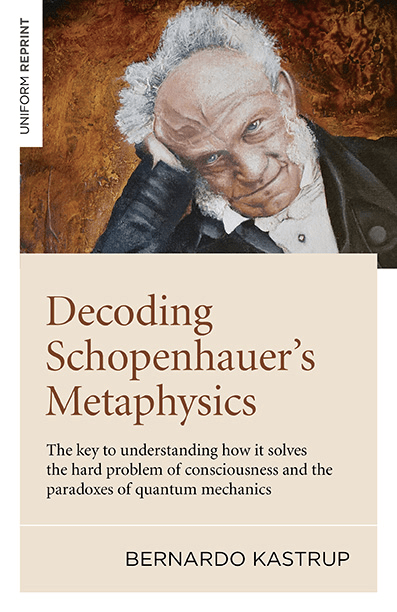
Decoding Schopenhauer’s Metaphysics: The Key to Understanding How It Solves the Hard Problem of Consciousness and the Paradoxes of Quantum Mechanics by Bernardo Kastrup
Schopenhauer’s metaphysics is characterized by partitioning the world into two categories: will and representation.
Representation = outer appearance of the world (the way it presents itself to our observation).
Will = the world’s inner essence (what it is in itself, independently of our observation).
This seems similar to dual-aspect theory:
mentality and physicality are two different aspects or views of the same underlying, fundamental ‘stuff’ of nature, which in turn is neither mental nor physical.
But Schopenhauer’s metaphysics is actually different from dural-aspect theory:
Will is not mentality
Representation is not physicality,
Rather, will is everything.
The physical world exists only insofar as it consists of mental images – representations – in the consciousness of the observing individual subject. It has no existence beyond this individual subject.
This world-in-itself is not physical, it is what remains of the world when it is not being observed-ie. when it is not being represented in the consciousness of an individual subject.
The will is the driving force of the universe.
All living organisms are dissociated alters of the will, each manifesting a character. But only living organisms (for some reason) and not inanimate objects (no Panpsychism!)-are individual subiects. Some of these individual subjects are capable only of reactions to stimuli (plants); others are also capable of perceptual representations (animals); and some are capable even of abstract representations (humans). Nonetheless, all are alters of the universal will.
Now that, whatever it was supposed to mean, is somehow, according to Kastrup, of relevance to solving the hard problem of consciousness.
////
But careful!! God need not to be invoked here: the driving, invisible force of the universe is no God, the manifestations/alters of this Will in all of the living organisms (and not inanimate objects) are not souls.
Then comes the suffering and volition part. Volition is the source of all suffering. By craving certain things in the world and rejecting others -rejection is also a form volition, just in reverse – alters constantly set themselves up for suffering. Salvation comes when you give up and deny your volition.
This all sounded a bit too familiar:
Here is a Google definition of Islam – complete. (Istislam). Complete surrender. Actively going to meet the Divine Will in complete and utter compliance.
////
Extra excerpts and notes
..
Schopenhauer is an idealist.
..
The experiential states construing the world beyond ourselves need not have any qualitative similarity whatsoever with the colors, tones, flavors, etcetera that we experience when observing such world.
..
In other words, what it feels like to be the universe surrounding us is rather different from what it feels like to perceive such universe. The experiential states underlying the world we inhabit are separate from, and at least ordinarily inaccessible to, us as individual observers; all we can access is their representations. ‘
..
The latter- which constitute what we call
the ‘physical world’-exist only insofar as we experience them as individual subjects. This implies subjective idealism in regard to the physical world.
Important point is that Schopenhauer’s metaphysics isn’t a form of dual-aspect theory, but idealist through and through: it entails both subjective idealism- the physical world of objects in spacetime existing only as images in an individual subject’s consciousness-and objective idealism-the world-in-itself being constituted by volitional experiential states.
..
Indeed, according to Schopenhauer the will is the inner essence of everything in) nature, without exception. There is nothing that isn’t will.
..
This way, what Schopenhauer means by ‘will is often not the will as a whole, but the raw, non-meta-conscious layer of the will underlying the intellect; a layer still in the will’s original, purely instinctive configuration.
..
That he often loosely refers to the latter simply as ‘will’ is just shorthand for ‘instinctive underlying layer of the will; it doesn’t actually contradict his contention that there ultimately is nothing to the intellect but the will proper, now in the full sense of the word.
..
Such mild terminology inconsistencies -entirely benign and hardly worthy of note in a colloquial setting – pervade Schopenhauer’s argument. It is nonetheless clear throughout that, ultimately, there is only the will. Even representation is merely the objectification or extrinsic appearance of the will.
..
Excitations of the will is powerful: it allows us to make sense of the wide qualitative differences between, say, love and fear, suffering and bliss, red and blue, without requiring anything other than the will itself. Different patterns of excitation -‘notes’-are what accounts for the different qualities of experience, even though the ‘instrument’ that plays these notes is always one and the same, “always entirely itself.”
..
For the same reason that there is nothing to ripples but the water in which they ripple, there is nothing to the myriad different experiential states of the will but the will itself, sole member of Schopenhauer’s reduction base. It is the unfathomable variety of the will’s behaviors -in the form of its self-excitations- that leads to the complexity of nature.
..
When Schopenhauer posits that experiential states are but excitations of a universal subject-i.e. the will -he is seeking to reduce the whole of nature to its sole given ontological category. After all, for the same reason that there is nothing to a vibrating guitar string but the string itself, there is, in this case, nothing to an experiential state of the will but the will itself.
..
Schopenhauer’s metaphysics is thus as parsimonious and epistemically reliable as any metaphysics could possibly be, as far as its reduction base is concerned.
..
Contrast this to mainstream physicalism. There, the reduction base consists of theoretical abstractions that, by definition, are essentially different from subjectivity -ie. fundamentally other than nature’s sole given (Kastrup 2018b).
..
After all, at a fundamental level, matter/energy isn’t–according to mainstream physicalism -a subject of experience; only particular arrangements thereof allegedly are, epiphenomenally.
Still at a fundamental level, matter/energy only abstract,
auantitatime prorerties-such as mass.
..
Plato = Kant = Schopenhauer
..
For Schopenhauer, each living creature is a distorted copy of an eternal Idea underlying its species. My cats are just distorted copies of the eternal Idea of ‘catness’; a particular dog is just a distorted copy of the eternal Idea of
‘dogness’; etc
Leave a comment